Canada is deciding what transparency should look like in an age of artificial intelligence.
Our community had a clear message: knowing that AI was used is only the beginning.
This summer, Innovation, Science and Economic Development Canada (ISED) launched a consultation on AI transparency, asking Canadians how AI use should be disclosed, how AI-generated content should be identified, what information developers and organizations should provide about AI systems, and how serious AI incidents should be reported. The consultation ran from July 23 to September 23 and will help inform future federal AI policy.
At Evidence for Democracy, we wanted our community to help shape our response. So we asked you!
We received 160 responses to our community survey on AI transparency and accountability. While this was a community consultation (not a representative poll of Canadians) the results revealed substantial agreement on several fundamental principles.
Above all, we heard that transparency must give people the information and rights they need to understand, scrutinize, and challenge how AI is used.
What we heard from our community
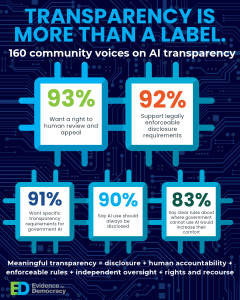
Our respondents overwhelmingly supported greater transparency:
- 89.6% said AI use should always be disclosed.
- 92.4% supported clear standards for labelling AI-generated content.
- 92.4% supported legally enforceable AI disclosure requirements.
- 93.1% supported a right to human review and appeal.
- 91.0% supported specific transparency requirements for government AI.
- Only 13.2% identified voluntary industry guidelines as something the government should prioritize.
But perhaps the most important finding was that respondents wanted more than disclosure.
People told us meaningful transparency should explain which AI system was used, what it did, why it was used, what information informed its output, how much human review occurred, and who remains responsible for the result.
Transparency should enable accountability
Imagine learning that AI helped determine whether you qualified for a government benefit.
A notice saying “AI was used in this decision/creation of this report/analysis of this data” tells you something… but probably not what you actually need to know.
It doesn’t say which system was used or how it ensured accuracy. We also don’t know what information and prompts the system received, or how it was tested, reviewed, or verified. This leaves users unsure who is responsible for the outcome or how to appeal it.
Questions about AI transparency increasingly become questions about accountability.
Our community repeatedly made this connection. 93.1% supported a right to human review and appeal, while open-ended responses emphasized that organizations should remain responsible for decisions made or informed by AI.
In our July Hill Times op-ed, “AI for all must be accountable to all,” we argued that Canada’s success on AI cannot be measured solely by how quickly people adopt these technologies. Public acceptance will also depend on whether people can trust the institutions and systems deploying them.
Trust must be earned through accountability.
This is a consistent finding across E4D’s AI research
This consultation intersects closely with several pieces of research E4D has conducted this year.
Our AI and Democracy: Navigating Trust, Truth, and Technology in Policymaking project examined how AI is already reshaping how the federal public service gathers evidence, analyzes information and makes decisions. The federal government’s first public AI Register, which documented more than 400 uses of AI across 42 federal organizations, prompted the research. Our work identified transparency, regulatory gaps, implementation challenges and the potential for biased or inappropriate use as significant questions for democratic accountability.
More recently, our report From Principles to Practice: A Comparative Analysis of AI Governance in Canada and the United States assessed AI governance across six dimensions—including Transparency and Public Record, alongside governance and oversight, public trust and democratic resilience, technical robustness, and public value. That work reinforced that trustworthy AI depends on the systems around the technology: oversight, public records, institutional capacity, and mechanisms that hold decision-makers accountable.
And our newest report, From Adoption to Accountability: A Roadmap for Implementing Canada’s AI Strategy and Strengthening Public Trust, examined what actually drives public trust in AI. We identified four interconnected areas Canada’s national AI strategy must address: literacy and education; technical standards and design; public engagement and democratic participation; and governance and regulation.
Together, these projects point toward the same conclusion our community reached in this consultation:
You cannot educate your way out of an accountability problem.
AI literacy can help Canadians understand the technology they encounter. But institutions must also show that AI systems are reliable, properly governed, independently scrutinized, and subject to meaningful democratic oversight.
Strong discomfort with consequential AI applications without human oversight
Our respondents were generally more comfortable with government uses of AI that support administrative or analytical work, and much less comfortable as AI became more involved in consequential decisions affecting people.
Around 60% were comfortable with governments using AI for administrative tasks or searching and organizing information. Comfort was lower for other applications:
- 46.5% were comfortable with AI assisting research or policy analysis;
- 24.3% with AI assisting decisions about government programs or benefits;
- 16.0% with AI assisting public-safety or national-security decisions;
- 13.9% with immigration, tax, or enforcement decisions affecting people; and
- just 3.5% with AI making decisions about individuals without human review.
These results do not necessarily mean there is a simple dividing line between AI that merely “assists” people and AI that exercises power. AI used for research, analysis, or administrative work can still influence consequential decisions.
Instead, one of the clearest messages from our consultation was that transparency should not dilute human accountability.
Respondents frequently emphasized that a qualified human should review or verify consequential AI outputs and decisions, particularly when they affect individuals. 93.1% supported a right to human review and appeal, and open-ended responses repeatedly stressed that the person or institution using AI must remain responsible for the outcome.
In other words, an organization should not be able to avoid responsibility simply because an AI system produced, recommended, or informed a decision.
Government use attracted particularly strong expectations. 91% of respondents supported specific transparency requirements for government AI, and participants called for measures such as public registries of high-impact systems, reporting on government AI use, greater disclosure around how systems influence decisions, and opportunities for independent scrutiny.
This also points toward a broader principle for AI governance: transparency and accountability obligations should increase with the consequences of an AI system’s use.
There are international models for this approach. The European Union’s AI Act, for example, uses a risk-based framework: some applications are prohibited outright, high-risk systems face stronger requirements—including risk assessment, documentation, traceability and human oversight—while other AI systems are subject primarily to specific transparency obligations.
Canada does not need to copy the European model wholesale. But the underlying principle is worth considering: a chatbot, an administrative tool, and an AI system influencing someone’s access to benefits or legal rights should not necessarily carry the same transparency and accountability obligations.
The more consequential the use, the stronger the case for meaningful disclosure, human oversight, independent scrutiny, and clear responsibility for the outcome.
Did Canada’s consultation ask the right questions?
We welcome the federal government’s decision to examine AI transparency.
The consultation recognized important issues, including identifying synthetic content, disclosing AI interactions, documenting AI systems, reporting serious incidents and tracing increasingly autonomous AI agents.
But the framing also left important questions unanswered.
The Canadian Centre for Policy Alternatives has argued that the consultation adopted too narrow a conception of transparency, focusing heavily on what people see when they encounter AI while paying less attention to questions about labour, data, environmental impacts, privacy and power across the AI supply chain. The CCPA also questioned whether a highly technical consultation format creates barriers to meaningful participation by people without specialized AI or policy expertise.
Those criticisms resonate with what our community told us.
Respondents raised concerns extending well beyond labels and disclosure, including privacy and data governance, accuracy and evidence, copyright and creative work, environmental impacts, misinformation, democratic accountability, and the concentration of technological power.
Transparency also differs from informed consent.
Telling someone that AI is being used does not necessarily mean they have meaningfully agreed to how their information will be collected, processed, or used. Data protection approaches such as the European Union’s GDPR distinguish between simply providing information and obtaining consent that is freely given, specific, informed, and unambiguous. They also recognize that people need understandable information about the purpose of data processing and meaningful opportunities to withdraw consent.
That distinction becomes particularly important as AI systems rely on large amounts of personal data, are repurposed for new applications, or influence consequential decisions. A disclosure notice may technically make an AI system more transparent while still leaving a person with little meaningful choice or control.
The federal government’s own use of AI in public consultations makes these questions especially relevant. ISED has previously disclosed that commercial AI models were used to help analyze tens of thousands of responses to its 2025 AI strategy consultation. The CCPA noted that participants were not told in advance how those tools would process their responses or how their data would be protected, and that the current transparency consultation only indicated conditionally that AI tools “may be used.”
People participating in a public consultation should know whether AI is analyzing their submission, what information is shared with an AI system, how their responses are categorized or summarized, what safeguards protect their information, and what role humans play in verifying the analysis.
For E4D, this question isn’t new
Long before generative AI entered the mainstream, E4D was asking a related question:
Can the public see how evidence contributes to the decisions the government makes?
Our Eyes on Evidence research examined the transparency of evidence use in policymaking across Canadian governments. One central finding was that governments often failed to clearly communicate the evidence behind policy decisions to citizens, even when they had formally committed to evidence-informed decision-making.
One of our guiding principles at E4D is that citizens cannot meaningfully hold governments accountable if they cannot understand how decisions were reached and what evidence informed them.
AI introduces a new layer to this longstanding transparency problem. As AI is increasingly built into the machinery of policymaking, transparency about AI becomes part of government transparency itself.
Five principles Canada should carry forward
Across our research and the feedback we received from our community, five principles consistently emerge.
- Disclosure must be meaningful: People should know when AI is being used—but also how, why and for what purpose.
- Humans must remain accountable: AI cannot become a mechanism for institutions to distance themselves from responsibility for decisions.
- Higher-risk uses require stronger protections: Governance should reflect what an AI system is used for and the consequences for affected people.
- Transparency needs enforcement and independent oversight: Disclosure matters more when backed by auditing, public reporting, enforceable rules, and independent scrutiny.
- Some uses may require limits and/or active informed content, not simply disclosure: Being transparent about an inappropriate or harmful use of AI does not make that use acceptable.
Read our full response
Our community feedback directly informed Evidence for Democracy’s submission to the Government of Canada’s consultation on AI transparency.
Read E4D’s full consultation response
The submission outlines our recommendations for meaningful disclosure, human accountability, stronger protections for higher-risk uses of AI, independent oversight, and clear limits where transparency alone is not enough.