
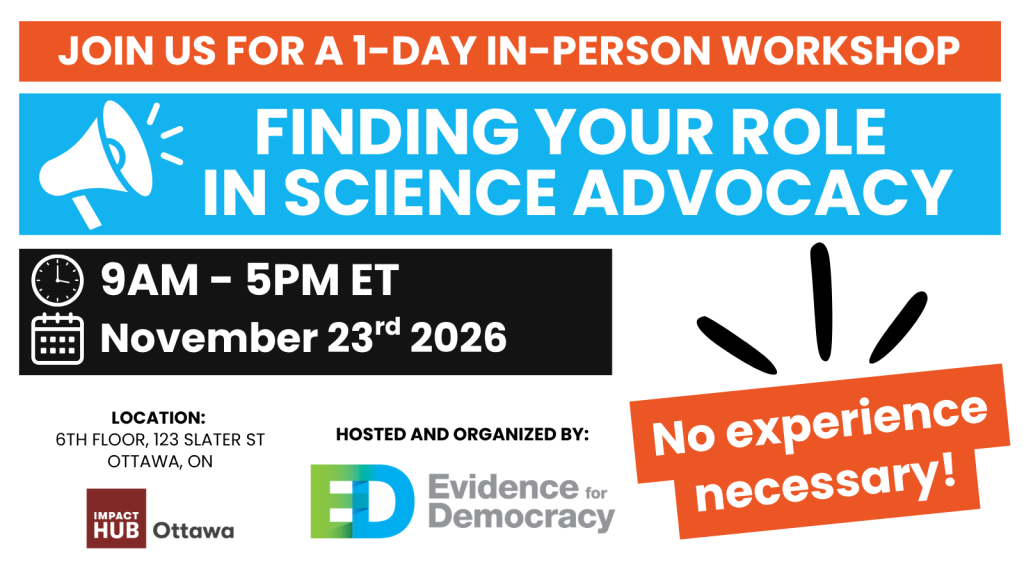
Do you want to get involved in science policy or advocacy but don’t know where to start? Then this workshop is for you!
You care about an issue. You have knowledge and expertise that could contribute to better decisions. But figuring out where you fit, who to talk to, what to ask for, and how to actually make an impact can be much harder.
Over one interactive day, Evidence for Democracy (E4D) will help you identify where you fit in science advocacy and develop a concrete, realistic plan for getting started. By the end of the workshop, you’ll have a practical guide to take your next step into advocacy.
Find your advocacy Sweet Spot
There is no single way for a scientist or researcher to contribute to public policy. You might provide expert advice, communicate evidence, build relationships with decision-makers, participate in a consultation, advocate for a particular change, support a community, or help translate knowledge between different groups.
The challenge is finding the role that makes sense for you.
Throughout the day, we’ll help you identify the intersection between:
- what you care about;
- the skills and expertise you bring;
- where evidence or knowledge is needed;
- who has the power to make change;
- the role you are comfortable playing; and
- what is realistic and sustainable for you.
We call this your advocacy sweet spot. Once you find it, we’ll help you turn it into a concrete goal and action plan.
Who is this workshop for?
This workshop is designed for scientists, researchers, graduate students, postdoctoral scholars, and other members of the research community who want to better understand how they can contribute to policy, public debate, and advocacy.
You might be wondering:
- How do I get involved in science policy?
- How can my research actually reach decision-makers?
- Can I advocate while maintaining my credibility as a scientist?
- Who should I talk to about an issue I care about?
- How do I turn something I care about into a concrete advocacy goal?
- How do I communicate my expertise to policymakers and other non-specialist audiences?
- How do I move from raising awareness to asking for a specific change?
- Where do I even start?
You do not need to arrive with all the answers. The purpose of the day is to help you work through those questions. You also don’t need previous experience in science policy or advocacy. Participants will choose an issue they care about and work through it step by step throughout the workshop.
Workshop at a glance
Morning: Understand the landscape
We’ll begin with the foundations of science policy and evidence-informed policymaking before turning the focus to you.
You’ll identify an issue you care about, examine the expertise and skills you bring, and explore where different forms of evidence and knowledge fit into decision-making.
We’ll then look at how government and policy decisions work and help you identify the stakeholders, institutions, and decision-makers connected to your issue.
Afternoon: Find your role and build your strategy
After lunch, we’ll explore the different roles scientists can play in advocacy and policy and help you identify the type of engagement that fits your values, comfort level, and capacity.
You’ll bring everything together to find your advocacy Sweet Spot, turn your issue into a concrete advocacy goal, and identify a specific ask.
Finally, we’ll move into policy communication. You’ll develop and practice a 60-second advocacy pitch tailored to a priority stakeholder before translating the day into a practical 30-, 60-, and 90-day action plan.
Event details
Date: November 23rd 2026
Time: 9:00 a.m.–5:00 p.m.
Arrival: Registration, coffee, and informal networking begin at 8:30 a.m.
Location: Impact Hub Ottawa, Ottawa, Ontario
Participants should plan to attend the full day, as the activities build on one another throughout the workshop.
About Evidence for Democracy
Evidence for Democracy (E4D) is a national, non-partisan, not-for-profit organization working to ensure that governments and policymakers use the best available evidence when making decisions that affect Canadians.
Through research, advocacy, training, and public engagement, we help strengthen the connections between science, evidence, policy, and democracy.
